Guides Your First Live Sessions
How Much to Buy In For at $1/2
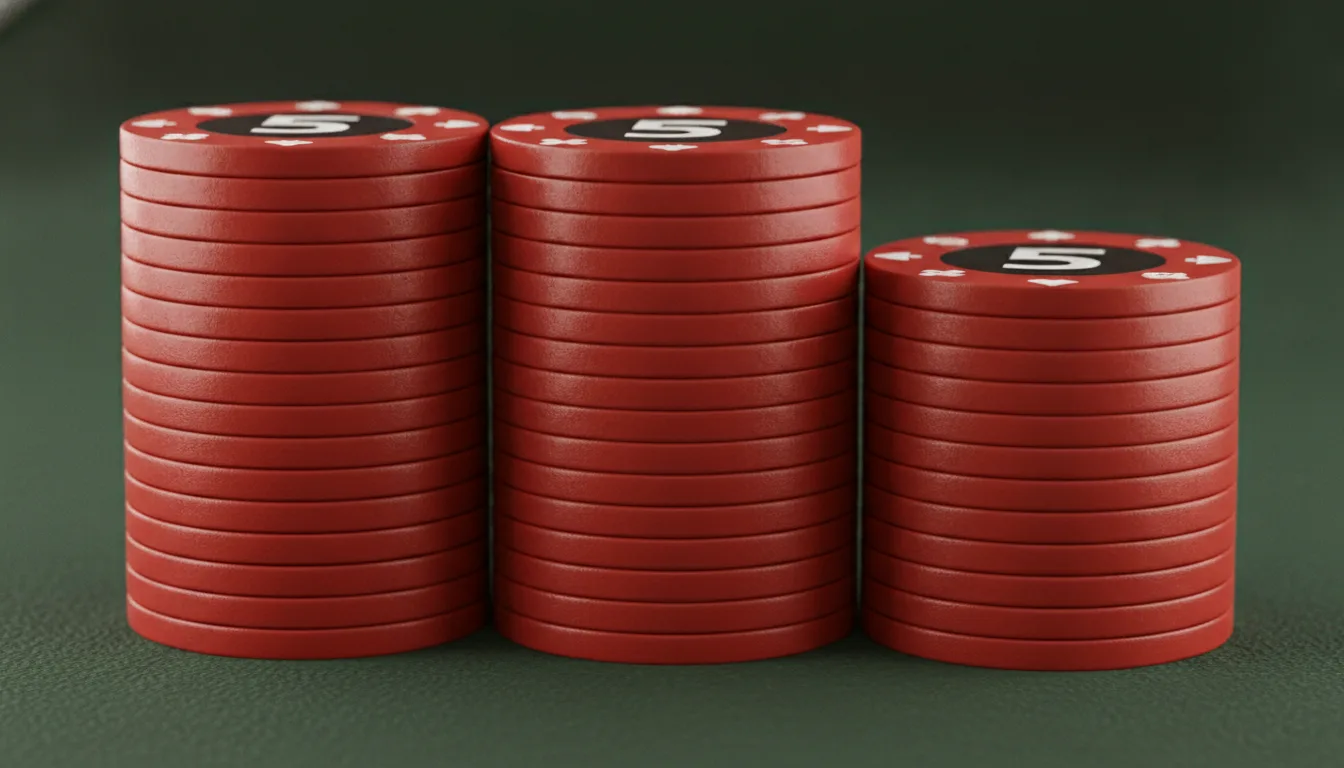
The buy-in decision takes three seconds and sets the ceiling on everything you can win at that table for the next four hours. Most $1/2 games cap at $200 or $300. Most players sit down for less than that, and it costs them.
The Money in Play Is the Smaller Stack
Against any one opponent, the most you can win is the smaller of the two stacks. Sit with $100 against a table of $400 stacks and you have volunteered to play a $100 game against players who are playing a $400 one. Every edge you have gets applied to a smaller number, and every hand you win gets capped.
That is the whole argument for the maximum buy-in, and it rests on skill compounding with depth rather than on gambling bigger. Deeper stacks mean more streets, more decisions, and more room for the person who reads better to be right more often.
What the Cap Actually Is
Rooms differ. Common caps at $1/2 are $200 (100 big blinds), $300 (150 big blinds), and occasionally $500 or uncapped in a bigger room. Minimums are usually $40 to $60. Ask the podium if the game list does not say, because the answer changes what a stack means: 100 big blinds and 300 big blinds are different games with the same name.
If the table is running a straddle, the effective game is bigger than the name. A $4 straddle turns $1/2 into something closer to $2/4, and a $200 buy-in that was 100 big blinds is now 50. Straddled tables are usually good tables, but sit with the maximum in them.
Effective stack, the number that matters, is the smaller of the two stacks in the hand. It changes with every opponent at the same table. Counting it fast is what the Chip Counting drill exists for: rendered stacks from your seat, including the ones half-hidden behind other stacks.
The Honest Case for a Short Stack
Buying in short is right in three situations, and wrong everywhere else.
- You are new and the maximum is more money than you want in play. Playing scared with $300 is worse than playing well with $150. Comfort is a real variable, and it shows up in your decisions.
- Your bankroll says so. If the maximum buy-in is more than about 5 percent of what you have set aside for poker, the variance is not worth the depth. See the bankroll guide for the arithmetic.
- The table is deep and you are outclassed. Rare at $1/2, but a table of four regulars playing $600 stacks is not the game a new player wants at full depth.
What a short stack costs you: implied odds die. Small pairs and suited connectors stop paying, because there is nothing left to win when you hit. If you sit short, tighten to hands that make top pair and strong second pair, and stop set-mining.
Topping Up, and the Awkward Middle
You can top up between hands, and you should. The dangerous stack size is $70 to $120 in a $300 game: too deep to be a comfortable short stack, too shallow to play a real pot. Anytime your stack drifts under about half the table maximum, reload to the cap.
Two mechanical notes. You cannot add chips in the middle of a hand, only between hands. And a table change resets nothing: bring your stack with you and top it up at the new seat.
What to Do When You Double Up
Nothing, mostly. A $600 stack at a $300-cap table is an advantage: you cover everyone, which means every one of their all-ins is capped by their stack and none of yours is. The mistake is treating the extra money as house money and playing it loose, which is how a doubled stack becomes a rebuy.
The one adjustment worth making is against the other big stack. When two deep stacks meet, the hand can get large, and hands that dominate cheaply (top pair with a weak kicker, for example) are exactly the wrong hands to build a large pot with.
Questions People Ask About This
Should I always buy in for the maximum at $1/2?
Usually yes, because the money you can win against any opponent is capped by the smaller stack, and depth favors the better player. The exceptions are a bankroll that cannot support it or a comfort level that would change how you play.
Can I add chips to my stack in the middle of a hand?
No. You can only add between hands. Whatever is in front of you when the cards come out is what plays for that hand.
Is a short buy-in strategy profitable at low stakes?
It can be, because it simplifies decisions to preflop and one street. It gives up implied odds entirely, so the hand selection that works deep is wrong short.