Guides Your First Live Sessions
What Actually Happens in Your First $1/2 Session
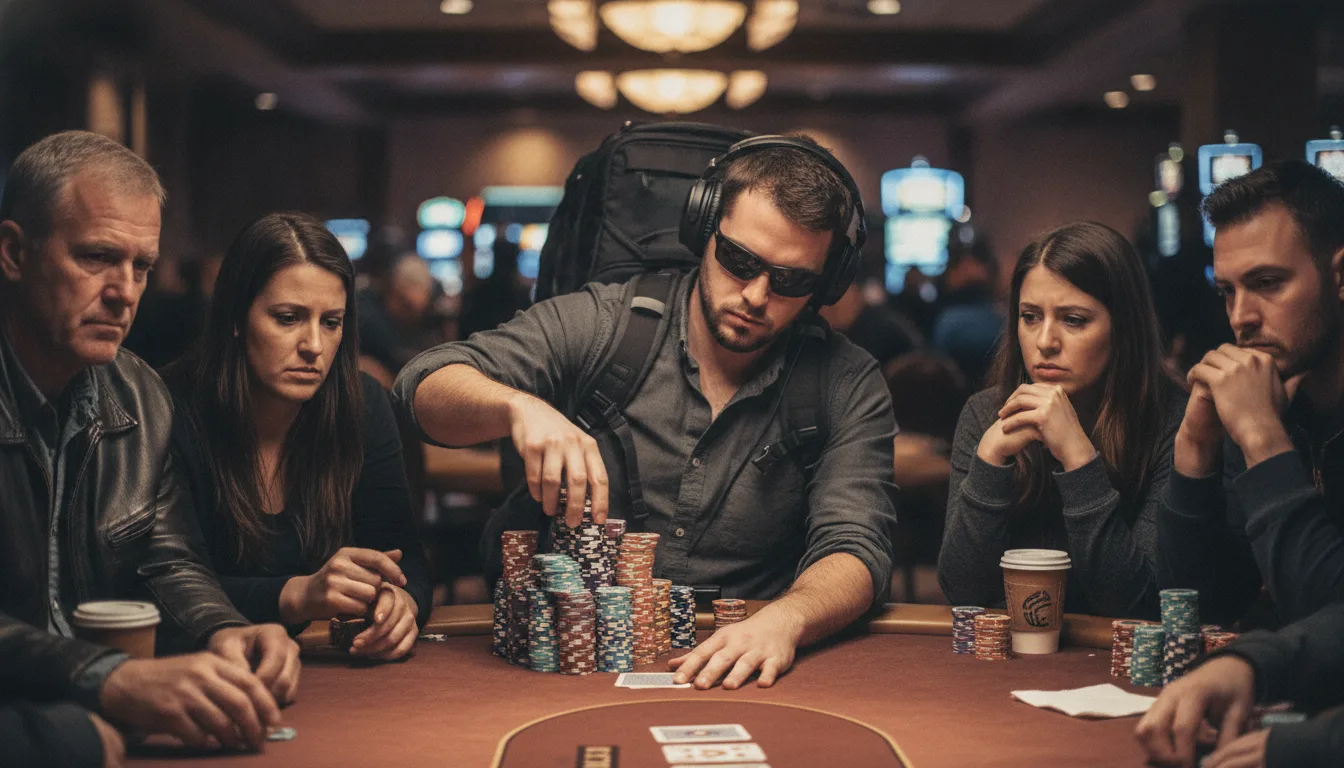
Online you sit down and the software does the work. Live, a dozen small mechanical things happen before your first hand, and every one of them is obvious to the eight people who have done it a thousand times. Here is the whole sequence, in order, so none of it is new when you walk in.
Before You Leave the House
Bring cash. Most rooms will not take a card at the table, and the ATM in the lobby charges what airport ATMs charge. Bring more than one buy-in, in small enough bills that you are not asking the dealer to break a hundred for the blinds. Leave the headphones if it is your first time: you are there to watch people, and you cannot watch people while a podcast is talking.
Check the room's page for the game list and the buy-in cap before you drive. A room running one $1/2 table on a Tuesday is a different night than a room running nine, and the second one gets you seated in ten minutes instead of two hours.
The List
You give your name at the podium and ask for $1/2 no limit. You get put on a list, usually on a screen on the wall, usually by first name and last initial. When your name is called you have a few minutes to claim the seat before it passes to the next player, so do not wander far.
Two things worth asking at the podium: whether the room has a must-move table, and whether there is a wait for the main game. A must-move is a feeder table you sit at until a seat opens in the main game. It plays the same, it just moves you later.
Buying In
You can buy chips at the podium or at the table from the dealer, who will take your cash and get chips to you within a hand or two. Until the chips arrive, you can play behind: the dealer knows the money is coming. Most $1/2 games cap the buy-in at $200 or $300, and most winning players sit down for the maximum, because the money you can win in a hand is capped by the smaller of the two stacks in it.
The chips will be mostly red $5 and white or blue $1. A full stack is twenty chips. Twenty reds is $100. That is the arithmetic you will do all night reading other people's stacks, and it is worth being fast at it before you need it.
Your First Orbit
You post the big blind or you wait for the blind to reach you. Waiting is free and it costs you nothing but time, so wait. Use the orbit to build the only thing you actually own on day one, which is information about eight strangers.
Watch for the obvious splits. Who is limping every hand and who is raising. Who counts out a bet in one motion and who fumbles. Who is drinking. Who has a rack of chips and the calm of someone who does this on Tuesdays, and who bought in for $60 and is playing like the money is already gone. You will not get subtle reads in one orbit. You will get the loose-passive players, and at $1/2 those are the ones the money comes from.
The first hour is the cheapest information you will ever buy. Play tight, watch hard, and let the table tell you who it is. The Player Observation drill runs the same exercise on demand: what is worth logging about this player, and what is just his baseline.
The Four Spots That Take Money from New Players
None of these are hard. All four are things nobody tells you.
- Calling raises out of position with hands that look pretty. KJ offsuit and QT offsuit are the hands that flop second best and pay off the hand that has you dominated. They cost more than any bluff you will ever run.
- Limping behind five limpers with a small pair, then folding the flop. The limp is fine. Folding a set is not, and neither is calling three streets with the pair itself. Small pairs are set-mining hands, and you flop a set about one time in eight.
- Paying off the nit. Every $1/2 table has one player who has folded for two hours. When he raises the turn, he has it. This is the single most reliable read in low-stakes live poker and it is available on your first night.
- Playing a stack you have not counted. If you do not know whether the villain has $180 or $600 behind, you cannot know what you are risking. Count stacks when the hand is not on you, not when it is.
Chips, Cards, and Not Annoying the Dealer
Keep your highest-value chips visible and in front. Protect your cards with a chip or a card cap so they do not get mucked by accident, which happens more than you would think in a raked pot with a fast dealer. Do not touch the pot. Announce your action before your chips move, because the amount you say is the amount that stands.
Full mechanics for all of that are in the rules guide, and the social half is in the etiquette guide. Both are short. Read them before you go rather than learning them from a floor ruling.
When to Leave
Set the stop before you sit, because you cannot set it at two in the morning while stuck. Two conditions end a first session: the game got worse, or you got worse. The first is a table full of regulars who all know each other. The second is you making calls you would not make in hour one. Neither is a failure. Both are information.
Then write down what happened while it is fresh: hours, result, and two hands you were not sure about. Twenty sessions of that is the only database you will ever have of your own game, and it costs you a notes app. The tracking guide covers what to record and what is noise.
Questions People Ask About This
How much money should I bring to a $1/2 game?
Bring at least two full buy-ins in cash, so $400 to $600 in a room that caps the game at $200 or $300. One buy-in and a bad cooler ends the night before you have learned anything.
Do I have to post a blind when I sit down?
No. You can wait for the big blind to reach you, which costs nothing but a few minutes. Posting immediately is optional and slightly worse.
Is $1/2 no limit good for beginners?
It is the standard entry point in most rooms, and the field is mostly recreational players. The trap is that the buy-in is small while the pots can get large relative to it, so stack sizes matter more than the stakes suggest.