Guides Math You Can Do at the Table
Counting Stacks From Across the Table
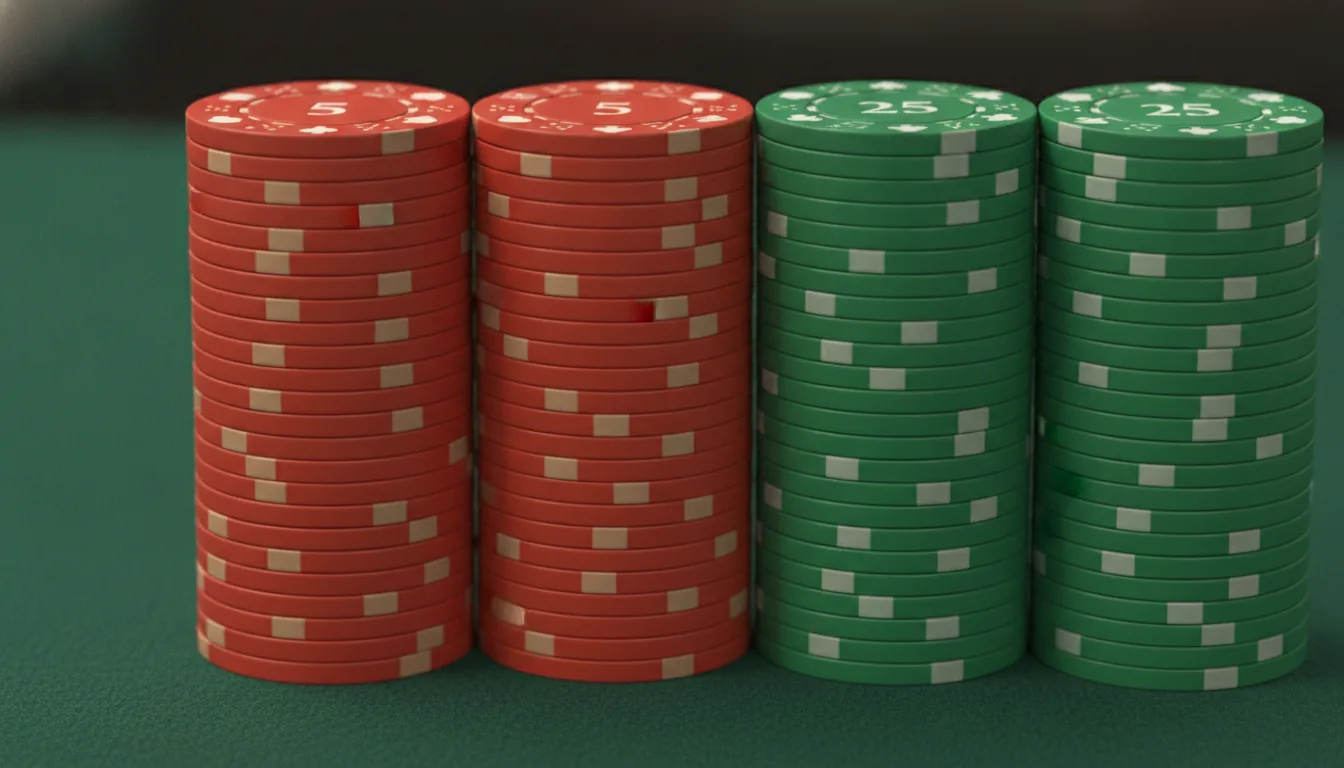
You cannot make a decision about money you have not counted. Stack reading is the most mechanical skill in live poker, it is entirely learnable, and almost nobody at $1/2 has bothered.
Color First, Height Second
Every stack read starts with denomination. Rooms vary, so confirm yours in the first orbit and then stop thinking about it.
| Color | Value | A full barrel of twenty |
|---|---|---|
| White or blue | $1 | $20 |
| Red | $5 | $100 |
| Green | $25 | $500 |
| Black | $100 | $2,000 |
A full stack, called a barrel, is twenty chips. Twenty reds is $100. Twenty greens is $500. That single conversion does most of the work: you are not counting chips, you are counting barrels and then reading the remainder off the top.
The Three-Step Read
- Count full barrels by color. Four red barrels is $400 before you look at anything else.
- Read the partial stacks against a full one. A stack that reaches two thirds of the height of a neighbouring barrel is about thirteen chips. You are comparing heights, not counting discs.
- Look for what is hidden. This is the step people skip, and it is the one that matters.
Hidden Chips
Most rooms require higher denominations to be visible, and most players comply loosely. A single black chip sitting behind a wall of red is $100 you did not count, which can be the difference between a stack you cover and a stack that covers you.
Count when the hand is not on you. Watching a stack while you are facing a bet is too late, and it is also a tell: a player who suddenly looks at your stack is a player considering a big bet.
The Chip Counting drill renders stacks the way you see them from your seat, at an angle, including the ones half-hidden behind other stacks. It generates fresh scenes rather than cycling photographs, so the answer never comes from remembering the picture.
Why the Number Matters More than It Looks
Against each opponent, the money in play is the smaller of the two stacks. That number, the effective stack, changes what your hand is worth before a single card comes out.
- Deep, meaning 150 big blinds or more: hands that make nuts go up in value. Small pairs, suited aces and suited connectors have something to win. Hands that make good-but-not-great top pairs go down, because the money goes in when you are beaten.
- Around 100 big blinds: the standard game. Top pair with a good kicker is a stack-off hand in most single-raised pots.
- Short, meaning 50 big blinds or less: implied odds die. Set-mining stops paying, and the hands that want to be all in preflop go up in value.
All three of those live at the same table simultaneously, because you are deep against one player and short against another. The buy-in guide covers the sizing decision that sets your side of it.
A Worked Read
Seat 6 has, from left to right: two full stacks of red, one stack of red that reaches a little past halfway up its neighbor, four loose reds in front, and a single green tucked behind the left-hand barrel.
Two barrels is $200. The partial stack is about twelve chips, so $60. Four loose reds is $20. The green is $25. That is $305, and roughly $300 is close enough to act on. The whole read takes about four seconds, and the part most players miss is the green chip, which is 8 percent of his stack sitting where you have to look for it.
Now do the thing that makes it useful. You have $420. Against seat 6 you are playing $305, which is about 150 big blinds, so set-mining is live and so are suited connectors. Against the short stack in seat 2 with $95, you are playing 47 big blinds, and none of that applies.
Two Habits Worth Building
Keep your own stack readable and organized in barrels. It speeds the game, it keeps you legal, and it means you always know your own number without counting.
Say the effective stack in your head when a hand starts. "I have $310, he has $185, we are playing $185." Ten seconds of that per hand, and stack size stops being something you reconstruct under pressure on the turn.
Questions People Ask About This
What is a barrel of poker chips?
A full stack of twenty chips. Twenty red $5 chips is $100, which is the conversion most live stack reading is built on.
What is the effective stack in poker?
The smaller of the two stacks in a hand, because that is the most that can be won or lost between those two players. It changes for every opponent at the same table.
Are players allowed to hide big chips behind small ones?
Most rooms require high denominations to be visible, and enforcement is uneven. Counting stacks while you are not in the hand is the reliable protection.